Showing posts with label children'S Books. Show all posts

Wednesday, March 11, 2020

Same Ideas; Different Stories


We're all looking at the same image. What do you see? It's inevitable that some, no doubt, will have different conclusions of what it could be; others may have similar views.  But no matter what, the perception of each individual is uniquely his/her own and nothing can detract from that.


So what's the point of this? Well, I've been asked for advice about this over the years and, recently, an aspiring author friend of mine called me with the same concern. He had finished his manuscript wanted to share it with a critique group but was worried that his idea might be stolen or plagiarised. I had to chuckle. He was calling from William Shakespeare's home town of Stratford Upon Avon, voicing his concerns about literary theft. The irony was not lost on me that  some conspiracy theorists have accused  Shakespeare of literally plagiarising the literary works of Christopher Marlowe.


Let me just say that plagiarism is an issue that should be taken seriously. Once your story is written, the IP belongs to you. However, can the idea for a story be stolen before it's written or published? For  example could an idea for a fantasy, sci-fi, romance or  even a biography be stolen? If that's one's fear, my suggestion is not to share the idea until you've written it into a story dated it, and emailed it to yourself or a lawyer if you want to engage one.

A well-respected award-winning author told me "Ideas are a dime a dozen. It's what you do with the idea that makes it your own." In other words, your original story can possibly be plagiarised but not the idea that inspired you.

When I was asked to pitch a story, the US publisher asked me to name books that my story could be compared to. My answer was it was Harry Potter meets Narnia with a twist of Monkey King. While most of those pitching were given a local contact to submit their completed manuscripts, the publisher gave me his  business card and asked me to contact him directly when the manuscript was finished.  You see, I stitched the concepts of wizardry, fantasy and myth  together to create my own original story (which I'm still writing) and it caught the publisher's imagination. 


Ideas have been shared for generations upon generations. If the concept of touch screen phones had not been floating around years ago, we might not even have Samsung, Huawei or Apple products today.  We'd all be using the same products from the same brand. How boring! And without the concept of diary-themed books like The Diary of Adrian Mole or The Diary of a Wimpy Kid,  we might not have the bestselling The Diary of Amos Lee series


Or would we even have the charming Prince Bear, Pauper Bear by Emily Lim just because Mark Twain developed that concept into The Prince and the Pauper well over a hundred years before she was born.


Even for non-fiction books, dozens of books have been written about famous sportsmen, actors, politicians and even the royals (But more on that later).

I'll give you an example of this. After Joseph Schooling won the Olympic medal in 2016, I wrote to his parents for permission to write a book about his Olympic journey. Permission was duly granted and I started writing Race to Rio: Joseph Schooling goes for Olympic Gold. But what I did not know at the time was that Times Publishing was in the midst of  publishing their own biography,  From Kid to King  by Marc Lim and  illustrated by Darel Seow. Both books are about the same subject, but both are written in different styles. One in verse; the other in prose. So did I plagiarise the idea. No. 


Ask yourself, did Star Wars and Battlestar Galactica plagiarise Star Trek's concept of conflicts in space? If so would that mean Marvel copied DC's  idea of superheroes saving the world?  And I guess Mission: Impossible  would then be guilty of ripping off  the spy genre from James Bond? 


When Prince William married Kate Middleton, there were a few picture books about the royal couple, but when they came to Singapore I decided to write a book about them too. I don’t have sole ownership on the idea about writing for royals, but my take on the subject  was my own: a story about the royals visiting Singapore with a surprise twist.


When I heard that Meghan Markle had adopted a shelter dog, I wanted to do a story about her dog Guy, and wouldn’t you know it, two other authors had the same idea and they published their books. The Duchess and Guy and  His Royal Dogness, Guy the Beagle.  My story The Royal Pup Pack: Party at the Palace was published in 2019. But before any of us wrote our books, Aby King wrote her book The Adventures of a Royal Dog. Did  I plagiarise the idea of a book about royal dogs. Did the other authors too? Absolutely not. The idea was in the public domain and our stories are totally different.


Well, if your fear is having your ideas copied, then my only advice is not to share your stories with anyone. Don't join any critique group. Don’t write. Don’t get your work published. Because if you worry about having your ideas stolen before you've written anything, you are focused on the wrong thing entirely.  Then when your book is published you'll worry that someone will plagiarise it.  Don't fret about things that may or may not happen, just write.
Is your ultimate goal about getting fame and glory for yourself or producing a good story? 

What should be your #1 priority is getting out the best story you can produce. Writing critique groups will help you test out your story. If someone wants to write a story with a similar concept to yours, so what. Your finished product will be totally different. Your writing styles will be totally different.  That is the amazing thing about creativity. There's enough room for everyone to share their stories about the same topic/genre in a public domain.


How many books are there out there about Princess Diana, the Queen, and Donald Trump?  Different books on the same subject provides the readers with a broader perspective on the subject matter. 


One does not have the right to tell someone what they should or should not write about. Writing is about inclusivity, not exclusivity. Writing community is about give and take, share and share a like.  Once your story is written it's yours. Don't be afraid to share your ideas, you may get some new ones. 

Speaking of which, I just got an idea to do a book about my dog, just like so many authors who've written about their own dogs. Not a new idea, but  I hope I'll make my story fun and original.


And by the way, to me, the only original book that has ever been written is the Bible, and even then there are so many different versions of it that have been published by different publishers. 

Friday, November 24, 2017

Thanksgiving


Another year has passed, and hopefully, I'm just a wee bit wiser. My birthday falls within a week of Thanksgiving so I might add this post is about giving thanks and gratitude.

I'm thankful for God putting up with me and be patient with me as I try to find my way through the daily journey that is life.

I am thankful for my family's constant and unwavering support. I'm grateful for each and every one of them and I should show it more. I am thankful for my few friends, both old and new (You know who you are) who have been there for me, through good times and the bad, especially the bad.

 I am thankful that I have a publisher who's been willing to publish me, even though I've been on a self-imposed publishing sabbatical for personal reasons. I'm thankful for my editors and publishers who have put up with my unique creative process. I've been inspirationally constipated for the longest time.

Now,  some people perceive what gratefulness means in terms of friendship.  Gratefulness and gratitude towards one's family and friends is a state of mind. It's about mutual respect, kindness, thoughtfulness, and consideration.

Gratefulness does not necessarily mean paying back favors though, naturally, one would want to do everything and anything to help a true friend and vice versa; it does not mean tit for tat, or I do this for you, so you should do that for me - That is no measure of gratefulness or of friendship. Gratitude or gratefulness means listening, even though  you may not agree with what is being said. It means you give the other party a chance to speak rather than dismissing them thoughtlessly. It means admitting one's  mistakes (no one is ever 100% right all of the time). It means wanting to do all you can to help whenever and where ever help is needed, no questions asked.

Gratitude towards others means appreciating people for who they are, not judging them or thinking one is always right when no one is right all the time. Gratitude is not about disparaging or mocking another person. Gratitude is about appreciating the people in your life, not taking them for granted and not taking advantage of them.

One can even have gratitude for those who have hurt oneself,  Be grateful for the lessons they have taught you. It does not matter if they don't have any remorse or guilt, forgive them anyway. They've given you an invaluable lesson. 

So this Thanksgiving, I am grateful to God, (Should make more of a concerted effort to put Him first), family, friends, and everyone who has ever taught me something.


Saturday, August 6, 2016

The Journey Home


Children's writers have to be very sensitive when they are dealing with a sensitive topic like death. I've seen some books that try to deal with topics like neglect or compassion and oh boy, I wish I had never picked them up.

You've got to know your subject really well and you can't make it didactic either, so it was with great delight that I received my copy of Charlotte Douglas's The Journey Home.

The author carefully traverses the landscape  spirituality and the well-spring of emotions that comes with the death of a loved one. In this beautiful heartwarming story, Oscar and Kiki's grandmother has passed away or has gone to her eternal home and with the help of their angel friends, Alexandra and Maksim, they realise that Grandma is with Grandpa, all her friends who have passed on before her and even Scottie, their cheeky dog.

This is a must read for any parent and any child, it will warm  hearts and bring tears to the eyes. In a world that is filled with so much war, anger and hate over the big things and small, this book reminds that life and love is precious and above all it is everlasting. Kudos to Charlotte Douglas for writing a masterpiece for kids and adults around the world to enjoy. And Nicola Spencer's illustrations are charming!  Make sure kids  look out for the bright shining yellow star on each page. The Journey Home is a treasure for the whole family.


Sunday, March 13, 2016

A Royal Adventure featured on Hello Online!

I'd just like to take the opportunity to thank Ms, Chloe Best and Hello online for featuring A Royal Adventure. I am thrilled to bits! Actually that would be an understatement. 


The book is due to hit the printing press in April and will be out in time for Charlotte's first birthday. The book, of course, is dedicated to the Princess in honour of the occasion. I am pledging my advance royalty payment to charity. Again thank you to Ms Best and Hello for everything!

Hello Online 


Monday, September 28, 2015

How Do Commissioned Book Projects Work?


Let's face it, a full-time author is never going to have a stable income from book royalties unless you're J.K. Rowling. So what's a writer to do? One option is to do school visits and talks, but most schools in Singapore are reluctant to pay decent rates; the other option is to take up commissioned projects.

My fellow authors, Emily Lim and Linn Shekinah have successfully published  commissioned picture books for the Singapore Zoo and the Public Utilities Board among others. But writing a commissioned project is far different from writing your own story. Your a hired gun so to speak and you may or may not have the final say on how your project turns out.


So how does a commissioned project work? What can you expect? I guess it varies from project to project, but here's the general gist:

1. You're either asked to submit a proposal or the client/publisher will approach you about working on a project. 


2. You'll be provided with a project brief which includes topics to be covered and the timeline. 


The Brief


3. The client may then ask for a sample of your writing or an outline for your story idea for consideration.


The Outline


4. Once offered the contract,  then you will have to negotiate your terms of engagement: 

Fee: For a commissioned project the author is usually paid a flat out fee rather than royalty payments. 

Rewrites:  I usually limit the number of rewrites to two. You don't want to end up in endless rounds of rewrites!

Kill Fee: In the event that the project fall through and your services are no longer required, you should insists on  a Kill Fee clause in your contract. That means you will still get paid something for your time and effort. E.G: A couple of years ago, I was commissioned by a financial institution to write a series of comic book stories based on their original concept. The project fell through but I was still paid for my effort.

5. Once a draft is approved, the illustrator begins to sketch the story out.

A tight sketch


 The blue damselfly was later
changed to a red dragonfly.

Final artwork.


6. Be patient and compromise. You don't have complete artistic control over the content of your project as the client is paying you to tell their story. But that doesn't mean you shouldn't compromise your creative integrity. 


With this project, Gardens agreed to use the characters from my existing Sam, Sebbie and Di-Di-Di series, so I guess I had a slightly easier time than other writers as I was already working with the familiar.  

Having said that, the project was not without its challenges.  How could I make the educational topics entertaining and fun without being overly didactic while sticking to the client's criteria? Thankfully I was lucky to work with a brilliant editor, illustrator, project manager and publisher, so that was sorted out as much as possible.

The whole project- from concept to completion - took up almost an entire year. The books were published early this month and are sold exclusively at Gardens by the Bay at $S58.00 for a set of four. So if you would like a set head on down there today!


Sunday, May 24, 2015

Book Illustrators Gallery Launch


Last Saturday I attended the launch of the Book Illustrators Gallery aka BIG at the National Library, which is the first  BIG (pardon the pun) event leading up to the annual Asian Festival of Children's Content. 

At the inaugural launch of BIG back in 2011, around 30 illustrations were featured.  But this year illustrators from Afghanistan, Australia, Canada, China, Hong Kong, India, Indonesia, Iran, Israel, Korea, Lithuania, Malaysia, New Zealand, Philippines, Russia, Singapore, Taiwan and the United Kingdom submitted  their works for consideration.  Out of the 150 entries, 103 were eventually selected for inclusion for the BIG.   It's really encouraging to see so many talented illustrators from around the world who are interested in having their artwork displayed at the BIG during the AFCC!


Book Council Ex-Co Member Koh Juat Muay and Gallery Curator Susanna Goho

One of the featured illustrators was my friend, Dave Liew and I convinced him to pose for a quick snap with his illustrations right before the launch. Oh, before I forget, my genius illustrator Soefara also has an illustration on display. 

David Liew

This year renown and popular illustrator Lee Kow Fong spoke about his journey as an illustrator.  He told the audience that it's never too late to start illustrating as he went for an illustration course  in the United Kingdom at the age of 39! I have to say that's very inspiriting  and there's still hope for me. In fact, I may just
follow suit even though I'm only 31 +++++++......

Lee Kow Fong

Next, Festival Director and Deputy Director of the National Book Development Council of Singapore, Kenneth Quek, delivered his opening address before presenting guest-of-honour, Venka Purushothaman, with  a  token of appreciation from gallery curator Susanna Goho.

Kenneth addresses the guests

Kenneth Quek,  Venka Purushothaman, and Susana Goho-Quek 
After the official launch, I managed to catch up with the guest-of- honour, Venka Purushothaman, Provost of Lasalle College of the Arts, to ask him about his thoughts on picture book illustrations.

What are your thoughts on children’s picture book illustrations?

Picture books, in terms of illustrations, are highly developed with much scope to grow. What I see is a lot of really in-depth reflection and reflexivity that’s emerging amongst young designers, illustrators and storytellers.  It’s something we should develop as a community of practice. With picture books people might look at the illustrations as images that inherently support the story.  But, in actual fact, illustrations have a whole ecology and economy of ways of telling stories and they have their own vocabulary, so I think it’s very important for us to celebrate that field and very specifically find ways to build discourse around it. Events like BIG (Book Illustrators Gallery) help build discourse. It’s not just about the images but what they really mean and how do they deepen our understanding of the world around us. So I think it’s a very significant area to be developed extensively through a community of practice.

Can you remember your first picture book?

Not really. I was a child who grew up on Mad Magazine. I was a child of the 70s. [At that time]  It was very much about the Walt Disney and Hanna Barbera way of illustrating  [cartoons] that influenced every young person through the medium of television. Television was the ‘book’ from which we loved to understand illustration. Having said that, the segue-way into the literary world is a very different aspect of it. In a sense the field of illustration and picture books were very divorced from each other. Things were illustrated in order to teach something. While the picture books are able to tell the story without the words. Of course there are historians who say that this links into cave paintings and whole structure of storytelling. In contemporary medium you have books, television and radio that tell stories in different ways.

Does Lasalle have a course on picture book illustration?

We actually do. We don’t teach it as a full course but we do have image and illustration [modules] on several fronts. First of all in Lasalle, the designers have to do storytelling through image making. Everything in art and design is about a story. But how do you express it? We have students who partner with art therapy students and they have created books just for the  therapeutic world. In the fine art world, we have been working with the medical sector with medical illustrations. Storytelling is a massively big part of the college and we believe that art and storytelling is not divorced.


What do you think of the illustrations you see here in Singapore?

The Singapore illustrations are phenomenal and there’s a lot of raw energy emerging and it requires a lot more mentorship and guidance and referencing to other international illustrators and people who have established practices.


Thank you, Mr Purushothaman.


Now, if you'd like to check out the Book Illustrators Gallery, head on down to the National Library. The exhibition runs until the 11th of June.


Wednesday, April 29, 2015

The Asian Festival of Children's Content 2015


It's almost time for the biggest children's literary event in the region - The Asian Festival of Children's Content - or AFCC as it is popularly known. 

If you're an aspiring author or illustrator, it's the place to be. This year the conference will be a week-long affair that includes a Teachers Congress, Parents Forum, and the Writers & Illustrators Conference as well as masterclasses, seminars, workshops and a media summit. 

Wendy Orr

With Sally Gardner
Susanne Gerry

Candy Gourlay, Wendy Orr, Sally Gardner, Susanne Gervay, Naomi Kojima, Marjorie Coughlan, Corinne Robson, Leonard Marcus, James Mayhew, Christopher Cheng, Ken Spillman, Andrew Weale, Norm Jorgensen, James Foley, Suzy Lee, Yusof Gajah, Emily Lim, Shamini Flint, Dianne Wolfer, Eliza Teoh, Mio Debnam,Adeline Foo, Sarah Odedina, Otto Fong, David Liew are just some of the illustrious speakers who have graced the event. 

Now if you're hankering to get your work discovered, I've got some great news for you. All aspiring authors and illustrators will  have a chance to pitch their story ideas at speed pitching sessions and they can also have their illustrations or stories critiqued at the First Look and First Pages critique panels. But space is extremely limited at each of these sessions so register quickly if you don't want to miss out on your potential big break. 


Leonard Marcus and James Mathew

Ken Spillman
Attendees will get a glimpse of the glitterati of the literati at the first awards of the literary award season. Just like Hollywood has the Golden Globes, The Screen Actors Guild Award and The Oscars,  AFCC has the SPBA, The HACBA and The SKTAA.

After weeks of anticipation, the authors and illustrators nominated for the Scholastic Picture Book Award,  Hedwig Anuar Children's Book Award, and Samsung KidsTime Author Award will finally find out who will walk away with the coveted prizes! 

Good luck to all the nominees. OK, I know everyone says that it's an honour to be nominated and it doesn't matter if they win or lose; the nomination is the award enough. Blah, blah, blah.  I say that's absolute rubbish! Rubbish, I say. Everyone wants to win! They really, really, do. Having been a previous Hedwig Anuar Children's Book Award nominee and speaking from experience *wink wink, nudge nudge*  I have to say I think it's a lot nicer to  accept the award and collect the winner's  cheque than to plaster a smile on your face and applaud graciously when someone else is announced as the winner.   (I'm an author, not an actor for crying out loud. LOL!;)) But I have to concede that if winning is not an option saying you were a nominee is the next best thing.


The Hedwig Anuar Children's Book Award
Though some say The Asian Festival of Children's Content is similar to the Bologna Children's Book Fair of the East,  but going back to my earlier Hollywood references, it is really more like the Oscars, the Oscars of the Asian children's literature scene. OK, so there won't be any paparazzi, red carpet appearances or even a red carpet for that matter. You won't have style reporters quizzing you about your AFCC fashions ( seriously what do children's writers and illustrators really know about fashion anyway?) and Wolgang Puck will not have a legion of his chefs whipping up a five-star Michelin banquet at the AFCC closing dinner. But that doesn't mean you should skip the festival! You'd be CRAZY if you did. It's a MUST ATTEND event! How are you going to get discovered if you're not willing to be seen, people?

Anyway this year's country of focus is China and I think that's fantastic as it's probably the biggest market for children's books around and it's still growing. Now, if you're like me  --a Chinese person who can't speak a word of language --  don't worry, the sessions will have live translation.


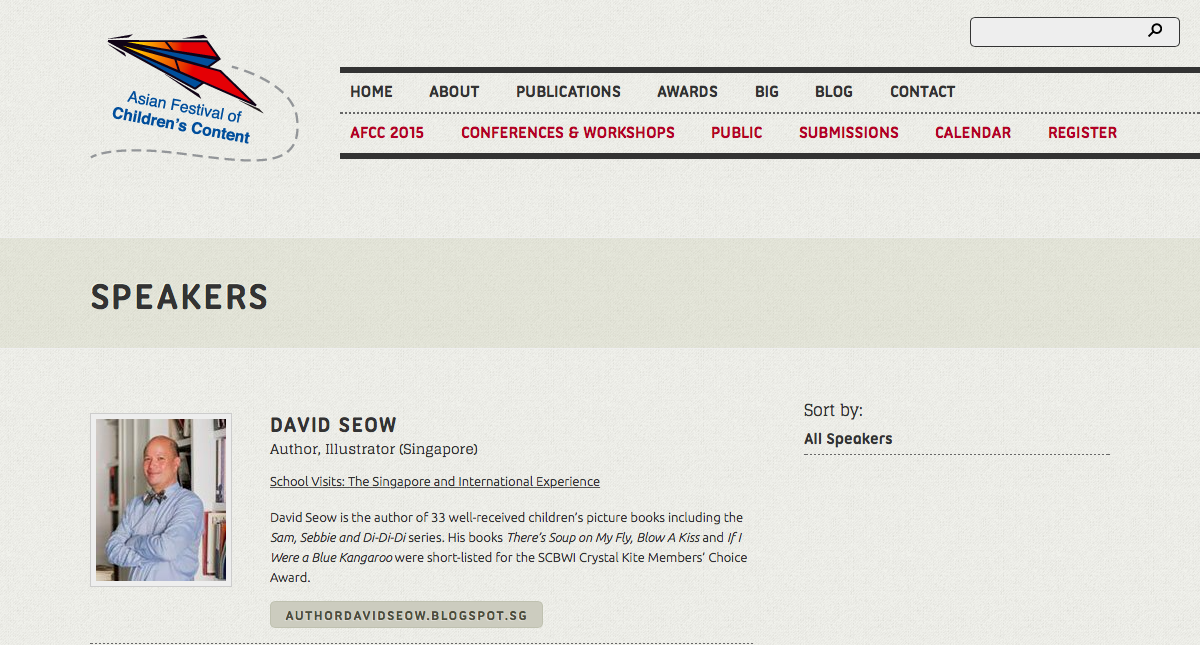
Oh, and this year, I'll be speaking on conducting school visits with my fellow author, Sarah Mousey, aka my biggest competition :). 
As you can see from the pic below, I've decided to shrink her down and made her bio really, really, really small. Hey, it's my blog and I can do what I want to!


You should come to our session so you can hear Sarah speaking in Chinese. (Through a translator  if we have one. If we don't, then some might not understand what Sarah's saying at all. LOL.
Sarah, you'll have to start your own blog to get back at me! :) :) So come on, people, what are you waiting for?  Register now! 


CLICK THIS LINK TO REGISTER


Search This Blog